

Don't Step Into My Office
An excerpt from the novel by David Fishkind, available January 13, 2026

Tomorrow, January 13, is the launch of David Fishkind’s “beguiling debut,” Don’t Step into My Office.
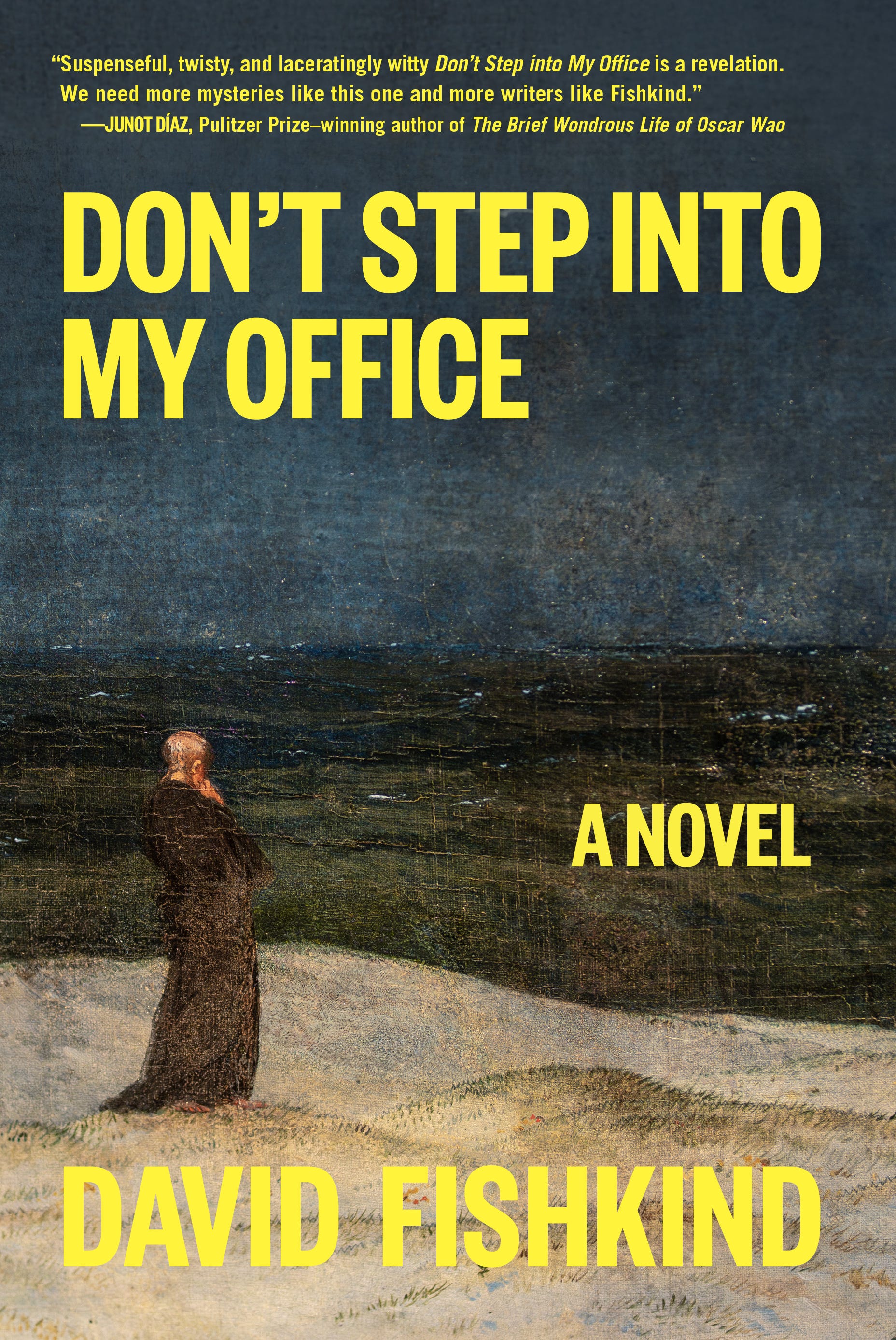
The first chapter of Fishkind’s novel originally appeared as a short story in Hobart, and now, almost three years later, the final novel will be available.
Don’t Step into my Office follows aspiring writer and general layabout Jacob Garlicker, who, on the night of his twenty-sixth birthday, witnesses a murder, and after a hapless attempt to help the victim, decides to move on and forget the incident entirely.
That is until seven years later, where the excerpt below picks up. Jacob is now blissfully married, mostly sober, and mostly at peace with his failed writing career. He’s feeling all right as he heads to his father-in-law’s birthday celebration in the Hamptons, even as he knows the well-heeled WASPs that populate his in-laws’ social circle will spend the weekend treating him with polite disdain. Everything shifts, however, when Jacob arrives on Long Island and begins to realize that those well-heeled WASPs are not as harmless as they seem.
Over the course of this propulsive, at times blackly comic narrative, Jacob wavers between addled narcissism and earnest commitment as he searches for the brutal, booze-soaked truth. Indebted to the suspenseful, page-turning plotwork of Patricia Highsmith and the operatic madness of Dario Argento, Don’t Step into My Office is a mesmerizing literary puzzle.
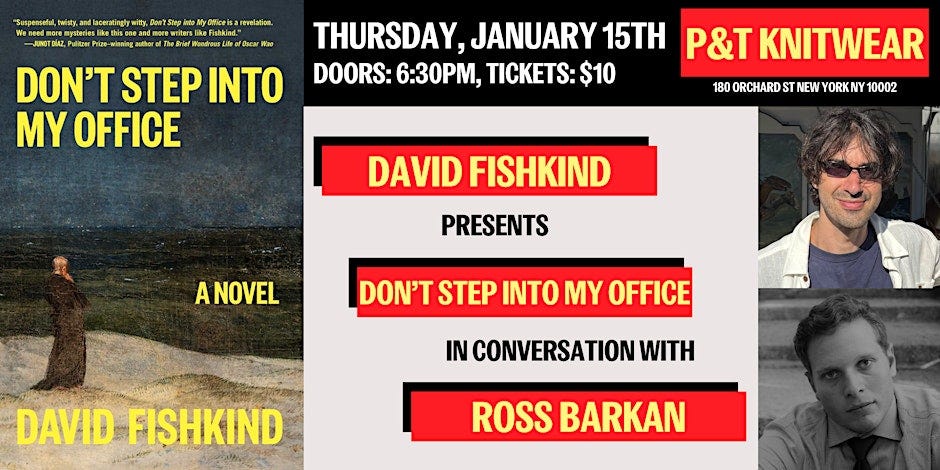
Pre-order now, or pick up at your local bookstore on January 13. If you’re in NYC, come to the launch event at P&T Knitwear in the Lower East Side on January 15 (ticket needed).
“Suspenseful, twisty, and laceratingly witty, Don’t Step into My Office is a revelation. We need more mysteries like this one and more writers like Fishkind.”—Junot Díaz, Pulitzer Prize–winning author of The Brief Wondrous Life of Oscar Wao
“Fishkind has written a delicious paradox: a thriller whose pages you want to flip through in a frenzy with prose so precise you want to savor every sentence.”—Zoe Dubno, author of Happiness and Love
“Once this gets its hooks into the reader, it doesn’t let go.”—Publishers Weekly
An Excerpt from Don’t Step Into My Office
The sky was smudged blue and ash. The sun tried to set behind lavender clouds and orange dust and it kept changing perspective as our ferry plummeted southwest, as though it, the old star, felt confused.
We’d barely undocked when the boat started to rattle. I looked up from my frayed, heavily annotated copy of The Great Gatsby I was not really reading and rolled it into a cone. Black belches of smoke were escaping some hatch pipe on the upper deck.
I’d ridden this route, perhaps this very vessel, dozens of times. I sat alfresco when weather permitted, and it had never shaken like this. The wrought iron pole of a tower viewer with its binoculars detached shivered in its foundation. Car alarms exploded from below. Buoys tossed in the harbor. Water surged white-green furrows.
But no one was reacting. They were looking at phones, taking photos, wresting dogs by their necks, leisurely talking, so I decided not to worry.
In the wake, I watched the little city in which both my parents had been born and raised shrink away. I saw the churches and rail yard, the parking lots and prison and electric and nuclear power plants, the scorched trees and wastewater facility fade in the atmosphere.
I kept my eye on the free-floating red brick lighthouse that marked the end of the river and the beginning of the sound. I watched it get bigger until it was precisely in front of me. It was one hundred and thirteen years old. It bobbed through time. Lights flickered within.
When it too was out of sight, I realized the rattling had stopped. No more smoke spewed from the ferry. The sky appeared muddier.
My wife was inside, by now hopefully finished being frustrated that we hadn’t had time to stop and get her an Italian ice, her heels propped on the cat carrier, forearm snarled by a rope harnessed around our dog’s torso.
Her parents and their house and their topiary and their reactions and memories and their colleagues and nemeses and friends awaited us across the inlet. Darkness fell. I couldn’t see.
I closed my eyes and thought about the island. Despite the hoops one was required to jump through to get there, it was so quiet, sumptuous and jammed with natural-seeming beauty, clean-smelling air, dense foliage.
It was worth the drama. And I didn’t belong. No matter how much I relished it, that easternmost county of the Empire State had a way of imposing my alienness. The shy shaded eyes of the ladies on the shoreline. They reclined, buffed and rebuffed, oblivious to it all, the terror world, and its missing pieces, the increasingly hostile status quo of the lesser nine months.
Skin changed with the sun and the sand. It protected them. Everyone was vulnerable, but some people had better defense mechanisms. Or it was something like that.
In the middle of my thirty-third year, I tugged at my collar. I burped. I itched. All my clothes were different. And everything that had happened in every person’s life skidded behind me as the wind blew off my hat.
It was a canvas bucket hat with the letter H on it. It had belonged to my father. I’d grabbed it off a pegboard in the basement of my parents’ abandoned Rhode Island condominium hardly an hour earlier, and already it was tumbling away.
I feigned an attempt to go after it, but was really only acting as a witness, resigned to all futility. Resigned and filled with fervor, permitting whatever the world needed to happen to take place.
I watched, vision adjusting to the dimness, as it toppled over itself through a gust and came to rest against the scaled liver spots of a varicose-veined shin. An ancient hag, seated along a blue bench, leaned deeper in her irrevocable hunch, grasping the brim between gnarled fingers adorned with heavy rings.
She examined the H with approval. I moved toward her, nodding. My lips pulled back.
—Very impressive, she croaked.
—Thanks.
—You wouldn’t know it, but I’m one of the world’s leading experts on the Protestant establishment.
—You don’t say, I said.
She managed some kind of flourish, transporting the upper half of her body against the bench back, my hat pummeling in the salty breeze.
—Life is full of surprises.
—Don’t I know it, I agreed.
She appeared to consider something.
—To where are you destined?
Her tone was wily. The faint rumble of car alarms.
—The Hamptons, I answered.
—It’s far less gauche to call it Long Island. Or even better, out east.
—But we’re . . . traveling south.
—Don’t get fresh, she snapped.
The woman handed me my hat, looking away into the opaque wall of murk, which became little spots of light as we began to approach the coast.
—Thank you, I said.
She took out a handkerchief like she was inspecting it for flaws.
—The natives called it Paumanok. The island that pays tribute. But it’s not the island that pays, now is it?
I paused.
—I don’t know.
The loudspeaker made an announcement, and I straightened.
—Well, I said. —Be seeing you.
The crone scattered particles into her pocket square. She waved me aside. Her hand cratered with divots, and I knew my wife would be putting everything into her tremendous tote bag, craning, helpless, waiting for me to come take the weight of Turmeric from under her Prada-shod feet.
And we were twisting away from each other, this ancient hag and me. Our lives parting forever. At some point I’d committed an error. Soon I would mean nothing.
Yet for the first time in the better part of the past seven years, I felt present: open, undissembled, resilient.
I found Emma exactly where I’d left her eighty minutes prior, inside the pet-friendly picnic table zone, poised forsakenly, upper body canting to one side under the heft of her tote, wearing dark Matsuda sunglasses amid the blackness of the night.
Houdini, our three-and-a-half-year-old Bedlington terrier, was panting compulsively, pink and gray tongue billowing from his jaw like a damaged web.
When he’d arrived in one of a grid of kennels in the back of a Sprinter van, making the journey from Little Egypt, Illinois, to Greenwich Village during the early months of the pandemic, he’d been panting. And as lockdown turned to protests, and placid side streets filled with flash-bangs and firetrucks, the skies with helicopters and long-range acoustic devices, he’d persisted. For a month, I’d assumed the organ was too big for his snout.
Eventually, though, he’d stopped. Only to unfurl the wet muscle at the first sign of distress. Being on a boat, I’d learned, was one of Houdini’s many triggers. I bent to ruffle his head. The dog ducked and attempted to slide between my wife’s legs.
—My family, I cried.
—Can you please take the cat?
—Of course, my love.
I cradled the carrier in my armpit. Battered plastic perforated with holes. Turmeric’s eyes shone from them.
—Mrow, I said.
Turmeric puled. An intercom crackled. I disencumbered the great bag from Emma’s shoulder. It was heavier than I’d expected, and I canted to one side as we made our way down the narrow stairwell to the vehicle deck.
Our 2003 Camry was parked in such a manner that I couldn’t imagine how we’d gotten out of it to begin with. The driver’s side door held flush against a solid rampart. Trunk obstructed by a Rivian R1T’s front bumper burrowing into our sun-bleached bernie beats trump sticker.
The ferry was roiling, docking. Houdini veered, his nose spraying bits of moisture, gulping fumes, one alarm still choking its warning, and the passenger side door gave just enough for me to unlock the car and thrust everyone in.
I clambered over wife and dog. The emergency brake sticking up like a dare.
—You know they used one of those to power a lobotomy last winter?
I swiveled toward Emma. She was blonde, petite, creamy-skinned, wrenched in her seat regarding the luxury electric pickup, all smooth and no clearance, through the rear windshield.
—Where did you read that, I asked.
—Twitter.
—The forces of the universe are so mysterious, I said.
—I’m exhausted, Emma exhaled.
—And hungry, I added.
She made a noise, and a gate opened at the end of the boat. Horns honked, and when I engaged the ignition, we were greeted with a familiar blast of canned air, the stereo blaring mid-song, —But hear that witch wind whinin’ . . .
I killed the volume and grinned.
—Sorry, I said.
Minutes passed before I realized it was the song Emma had chosen to begin the moment we’d kissed, ten months earlier, and pranced up the aisle we’d only just descended, our marriage conducted, and our futures brand new.
I wasn’t particularly fond of music, and I turned the volume back up at a snail’s pace, but the ballad must have concluded. The speakers emitted a soft hum like waiting. We filed behind a Tesla, a Land Rover, an Alfa Romeo. The pale light of the moon, which had been full three nights before, dipped between sheets of haze.
The dog was trying to stand on the cat carrier in the back seat. I kept glancing at the rearview mirror, breathing through my nose, relaxing.
I couldn’t think of what to say. Inanity, which had proven so innate to my solitude, lately came to afflict and undermine my self-assurance. Ever since I’d elected to share my life with other creatures.
I shot a quick look at Emma, barely registering her reaction, and turned to face the road as soon as I sensed her acknowledgement of my sightline.
What worlds existed within my wife? What secrets?
I should try to express that I’m relaxing, I thought. Then we can be more connected. Perhaps her reserve was just deference to my cold exterior. I only needed to let her in.
Shadows of tree limbs reached through the windshield, graved our faces with crisscrossing lines.
—I’m stressed out, I said.
—Really, Emma asked. —Why?
Before I could think of an answer, she was slapping the dashboard. Houdini vaulted over the center console onto her lap.
—Look, look, she was saying. —Stop here! Go! Go! Turn left!
She squeezed my thigh, and I swerved into the parking lot. The quaint red candy man sign kindled by headlights. Oyster shells crunched under tires. The Camry bucked. The cat carrier bounced. Turmeric howled. Houdini clawed at the window glass.
—Everyone okay?
Emma splayed across the upholstery, digging through her tote bag. She flung back golden tresses, felt wallet in hand.
—I’ll just be a second, she jumped out of the car.
A bell tinkled as the door swung behind her, and Emma disappeared into the store. I rolled down the window, cut the engine. The scent of brackish humidity. Sedate cricket murmurs.
I could see the slender outline of my wife’s body pulling boxes off shelves, weighing plastic baggies in upturned palms like the scales of justice.
Emma dumped a heap on the countertop. She was wearing a heather charcoal pleated skirt and cotton panties I glimpsed among the frenzy. A wan figure materialized, metallic calculator
in hand, and she and Emma embraced.
—Thank you, my wife called, package-loaded to her neck, jostling push bar with rear end. —And happy Fourth!
The figure bowed, a gesture between reverence and burlesque, tip jar burnished with dust, as Emma lashed her head in my direction, bell clanging.
—Come on now, she urged, slipping into her imitation of my own Cockney parody. —Get the door for your gentle consort, I does be requiring my victuals.
Twenty minutes later, she balled a small mountain of cellophane wrappers in the glove compartment and suspired. I stared into the windshield, smiling.
—I was so hungry, Emma giggled.
—I know, my love.
I listened to the tires whir.
—Anything in there for me?
We were winding around the island, heading back in the direction we’d come from, but on the southern fork, enclosing the bay. Houdini had stopped panting.
Emma dug through the bag of dark pecan turtles, white chocolate pretzel bark, hand-dipped yogurt-covered coconut drops, ring jells, marzipan, and candy-coated animal crackers.
—Licorice, she asked. —Is licorice gluten-free?
—Anise is a flavor all about being an alcoholic.
She scrutinized the label.
—It isn’t, she said. —I’m sorry.
My wife leaned over the center console. She planted a kiss on my forehead. She took my chin in her hand and tilted it to hers. My eyes strained, then briefly closed.
Our tongues explored each other’s surfaces. I tasted sugar and milk. I imagined the trace remnants of wheat varnishing the failures of my intestinal folds.
Lip suction released an audible pop. I returned my gaze to the road. A family of deer, the rats of Suffolk County, lined up at a crosswalk.
Emma rolled a fat joint on her skirt. She licked the paper, sparked up, cracked a window, took a deep hit, and held it. Two slivers of smoke escaped her nostrils. Then she dragged harder until half the paper was consumed in her dilating lungs.
We passed a gigantic ferrocement duck with a door embedded in its breast. Emma let out the cloud like it was going to rain, leaned her cheek on the window, and relinquished the smoldering roach.
—I’m going to rest my eyes.
Her hair curled. I touched it, barely. Then I finished the joint, jettisoning the cardboard filter through the slit in the glass.
—Good night, I said.
I listened to their breath, my three alive companions, bound by devotion, kindness, intent, food, and excrement.
Turmeric had lost a front fang and about half her lives since we’d fled the city and she’d discovered the great outdoors. Her nose was crushed in, and she whistled like a garden gnome, ticking the seconds off our journey.
Houdini had settled back into my wife’s lap. He was too big for it, though, and one paw rested on the dash. His tail wafted over a titian-tinted buttonhole of a rectum. And Emma sank into the passenger window. Her calves rising involuntarily, skirt gathering at the crotch, revealing her perfect white ass.
I’d handled three out of four of our carpool’s ordure, including my own, in the past month at best. My firm, wandering lump having taken on a dictatorial role, delivering me to humility when I needed it most, or didn’t.
Poop was reality. We were dispatched to a world among shit. Part of the deal of getting married was Emma wanted kids. Like most men of my generation, of all generations, I remained reluctant. I could only hope, after prolonged investment in hygienic instruction, that new guard would respectively pay the gift forward. Or rather, back. In the meantime, we ministered to our pets. Life found a way of inclining one toward fecal maintenance, which was fine, if you could afford to come to terms with it.
And suddenly, I knew exactly where I was. The ivory manor, paint peeling, picket-fenced, and red geraniums in its window boxes, overlooking the traffic light. I turned left, passed the windmill, the pond, the library, the bagel-cum-pizza parlor, the Michelin-starred fried chicken deli, the pop-up galleries, and the Balenciaga store.
I weaved by farm stands. A marquee buzzed with insects outside the live music bar. Weathervanes and cupolas cropped up behind hedgerows. The perfume of the fish market, and my alien return to the cedar-shingled cottage just north of the twolane highway was complete.
An American flag quivered. And as I pulled in the driveway, I scarcely recognized the neighbor’s towering A-frame beside us. Since the previous summer, it had been slathered a glossy black. The porch raised, affixed with perplexing wrought iron ornaments. The column of oaks separating this monstrosity from my in-laws’ modest Cape Cod–style house was badly pruned. A pickleball court had been poured, and a yard sign sagged in the scrubby crabgrass, broadcasting marabelle minnowitter agency’s claim on the eyesore.
I shuddered. Houdini lunged to the window. It appeared as though every light inside my wife’s parents’ property burned.
I negotiated a sharp U-turn and parked on the pine needle–strewn dirt. The passenger door creaked open. The dog collapsed in the brush. Turmeric bayed. Emma yawned. Less than an hour now remained before her father’s birthday would start.
While my wife hung out the trunk looking for something, I righted Turmeric’s carrier and unfastened it. I cradled her in my arms.
—Little grimble, I cooed.
I kissed her nose. She was covered in delicate camouflaging motifs, and once free, she’d vanish for days at a time, scandalous and aloof. If she could shrug, I think it’s all my cat would do, carcass of a decapitated chipmunk languishing from her jowls. She swiped my arm, and I dropped her, and she darted past a shrub clipped into the likeness of a hedgehog through a hole in the fence to the backyard and a tall growth of pines.
—Consarn you, I called, shaking my fist. —Your name is yellow!
Houdini elongated, performing a splendid yoga flow. Emma had bags on each shoulder, plus a rolling suitcase, and she reeled away. The dog looked longingly after her, then at me. I patted my thigh, and we followed her to the light.
—We’re here, my wife cried. The screen door banged between us. I held it open for Houdini, who lifted his leg and urinated on the side of the garage before scurrying under my outstretched arm. A vintage celadon Fiat and pristine white M3 groveled below an exposed bulb.
I basked in the whine of the door’s hinge, the twinkle of fireflies, the distant crash of the ocean, watched the Camry’s headlights blink out automatically.
Inside, I found my father-in-law lying on a towel on the kitchen floor, head propped up by pillows, Eames chair moored under his slippers, feet elevated in an anti-inflammatory pose. A juice glass rested next to his ear filled with red wine. On the counter overlooking him, a CRT Panasonic with built-in VCR flaunted images from one of the various foreign wars our country was funding.
—Michael, I said.
—Hey Jacob.
I crouched, extending a convoluted sort of hug over his body.
—Happy almost birthday.
—Oh man, Michael said. —Get a look at what they’re doing to our boys!
I leaned back and sat on my hands. The TV showed night-vision images of tanks driving over mud.
—That’s . . . awful.
—It’s the absolute pits!
—I hope . . . the war ends, I said.
—Well everyone hopes the war ends. But no one should even be thinking about peace talks until all territory has been reclaimed with just action.
—I, um . . . yeah. Territory is so important.
The screen flared. It showed all white for a second, then the armored vehicles resumed driving.
—Holy hell, Michael griped.
—Oh cheer up, Jane scolded.
Her voice was warm like pie, but my mother-in-law was actually holding a Danish over her husband’s hoary head.
I stood up. Assessing him from above, I could see Michael’s glasses had fallen off. His hair was tied back. It had been braided at some point and come stringily undone.
—Take this away from me, she pleaded, foisting the pastry in my direction.
I faltered.
—Would that I could, but . . .
—How many times do I have to tell you, Emma screamed from some unseen corner. —Jacob’s gluten-free!
—Oh that’s right, Jane rebuked herself. —Foolish, forgetful, and flabby! Oh, but it’s so nice to see you!
We hugged, and she kissed my cheek, flakes of Danish coming off on the back of my shirt and raining down to Michael’s face.
—I can help you with that, Janey.
He arched, reaching.
—Open up, mister seventy, she said and deposited the crumbs between his coffee-, wine-, and cigar–stained teeth.
—I’m not seventy yet!
My father-in-law ejected dough morsels.
—No, and you might not make it if you don’t chew your dessert.
—Are you excited for your party, I asked.
—I’m trying to look on the bright side. But I never thought I’d see the day they’d pay such desecration to our honorable troops.
He pawed for the juice glass. Jane moved it to his hand, and Emma appeared, changed out of her skirt and sunglasses into baggy linen pants and an oversized hoodie that said wit’s end.
—You were arrested twice protesting Vietnam, she said, feeding herself from a saucer of licorice pellets.
—That was different, Emmeline. I could’ve been drafted.
—I’m not talking about this.
—Are we supposed to stand idly by while evil totalitarians erode the world’s democracy?
—Yes, Emma said. —And take down that grotesque, fascist flag you’ve got hanging out front.
—It was Independence Day, Jane butted in.
—Have a little pride in your homeland.
—We would’ve stuck out like sore thumbs.
—Better than reveling in the blood of innocents.
—Who’s innocent, Michael rasped.
—Who are we talking about, I asked.
—This is ridiculous, Emma moaned. —I’m going to bed!
My wife swallowed the rest of her licorice whole, marched out of view, slammed a door.
—She’s had a long evening, I said.
Jane nodded, her eyes gracious and flashing behind some impenetrable cognizance.
—And with her new job starting Monday . . .
—Oh, we’re so excited for her! We’re so excited you’re here, my mother-in-law effused. —Can I get you a drink?
—So are we, I said, ignoring her question. —We really are. Only twenty minutes till the big day. I’m going to get in a position like you.
I regarded Michael. He was attempting to tip the juice glass toward his mouth.
—You gotta treat your body like a temple, he said.
In the bedroom, my wife was squatted over her unzipped suitcase, reassembling a bong. From photos, I knew the room had been decorated the same since Emma’s childhood.
Stuffed pigs hovered from high shelves, encircled by Polaroids of a picnic on a volcano, a commencement ceremony, swimming with dolphins in some tropical locale. There were consolation ribbons discolored by time. Something about horses, though I knew Emma had never, not even as a preadolescent, enjoyed riding.
An early format plasma television was mounted above a vanity and dresser, hand-painted with Matisse cutout-style silhouettes, and dappled with picked-at band stickers. The perimeter of the room papered in an off-pink, floral whorl.
Emma filled the bong’s reservoir from a liter of Smartwater.
She cocked the pipe, eyes crossed looking down as the chamber purled and the glass brimmed with vapor.
I took the tube from her clutches and a good rip and stared into the wall. Grim, carnival faces appeared in the repeating arrangement of rosebuds and vines. I shook my head.
—Nice, I coughed.
Emma unpacked. She hung two Lacoste tennis dresses in the closet. She piled books under the bedside lamp. She stacked shoes in dresser drawers and slid them away.
I lay down on the Turkish zoo animal rug. Houdini, sandwiched beneath the box spring, blinked at me. I blinked back. Emma took another hit, tucked her legs under her knees in a diamond pose, and covered her face with her hands.
—What’s up, baby?
—I’m stressed out, she mumbled.
—Are you sure? Remember when I said that earlier? I was really feeling relaxed.
—No, she said.
—No, you’re not stressed out, or no . . . something else?
—When did my dad get so old?
—He’s not old for another . . . I padded around for my phone, couldn’t find it. —Probably ten minutes.
—He loves war.
—Sixty-nine is fine, I said.
—And my mom doesn’t even seem to notice.
—Seventy is heavenly.
—And I don’t want to start my new job.
—Oho, I intoned. —So that’s it.
—No, Emma said.
—Don’t you want . . . health insurance?
—No.
—And a . . . 401(k)?
—No.
—What about . . . disposable income?
—That’s better.
She did a backward somersault, rose to stand, and suckled the bong. I did too. We lay on the quilt, covered in patches, flayed, falling apart. I put my hand in my wife’s pants.
—Are you excited for your dad’s birthday party?
—Gah, Emma grumbled and laughed. Then her tone became stilted. —I’m actually not.
—Well I am, I said. —I’m married to a woman with a job.
—And I’m married to . . .
—A slob.
—A starving artist.
—I’m doing my best to gain the weight back.
My hand sought deeper crevices, danker pastures. It moved faster, investigating.
—But it’s true, I insinuated. —I’m your fruitless nobody. Such a neurotic, slovenly boor.
—You’re no bore.
Emma folded her lips in my neck.
—Such a loutish, draggletailed slob, I insisted.
She ran her tongue over my jugular, sampling, savoring. She nibbled.
—Not a slob, Emma said. —You’re getting the whole thing mixed up. It’s your knob . . . that’s . . . in need of . . .
She slithered, limbs multiplying, each digit a tentacle, gliding and glazing across me.
—My slobber, she gurgled, undoing my trousers, easing them down in sinuous embrace.
—God, that’s right, I took over the narration, as her throat filled with me. —I was mistaken. It’s my . . . knob . . . that’s in need of a . . . sloberous . . . cure . . . It’s all . . . I forgot the thread.
And we stopped talking for seven minutes or so, yielding ourselves to each other, blissful and stoned and loosed from the minutiae of the world.
When we came back to earth, Houdini had resurfaced and was rumpled by the door, facing away from us.
—Mm, Emma sighed. —That was nice.
—Yes, it was. The dog’s pissed.
—That’s how you know.
My wife was right.
—We should do that more often.
—How often are married couples supposed to?
—Hm, Emma pretended to think. —At least once every five or six weeks.
I tried to remember the last time.
—Five weeks sounds about right.
—Something wrong?
—No.
—You don’t think we’re supposed to be making love more frequently?
—I think . . .
I wanted another hit. But for it to be opium or something. Something stronger than what weed could contact.
—I think we’re supposed to do it as frequently as we want. Anyway, it’s like . . . I don’t know. I think the only thing wrong with lovemaking in general is its regimented depiction in media. Desire doesn’t need a schedule. It waxes and wanes. It’s tidal. So what if conditions haven’t exactly been fuckfestive the past few months.
—Fuckfestive, Emma echoed.
I was staring at the stuccoed ceiling. There should’ve been a fan.
—I just mean . . . Sorry, I said. —Maybe you’re trying to say you want to make love more. I’m sorry. I get confused. It’s been hard for me to be in the moment lately. All this stuff about parents, and . . . I mean, you know. Never mind. It’s just been hard for me to feel carefree.
A hot breeze grinded the old clapboard shutters against the cottage.
—But I felt present tonight? I felt relaxed? I love you vigorously, Emma, no matter how often.
—Prove it, hub.
—How?
—Meet me back here in a week.
—I’ll see what I can do. What day is it again?
—I want you to put a baby in me, Emma said.
—Loud and clear.
—I’m teasing. Or . . . I’m not.
—That’s why you got a job.
—You know what I mean.
—Health insurance.
—That’s why women ever get jobs. But listen. Jacob. It was perfect. Everything is going to be okay. Everything will be normal again. Or . . . that’s the wrong word. Not normal, but . . .
—It’s okay, I interrupted.
I sat and clamped on boxers and cracked the door for the dog. He squeaked out, nails clicking, as Emma reached for the bong.
I glanced at the window, trying to remember the moon. It was washed out by the bedside lamp though, and I only saw shades of myself. The faint mole on my lover’s left hip.
There were things I should do, like brush my teeth or pee or stretch, probe vital unknowns. But I took another hit and lay back down and started counting instead, asleep with the room entirely lit up before I got to double digits.
David Fishkind was born in Massachusetts. His writing has appeared in The Believer, New York Tyrant, Forever Magazine, and The Paris Review. Don’t Step into My Office is his first novel.
“A wicked literary opera, complete with blood and guts, that plays out like a shredded film and stitches itself back together, blissfully, only when the curtain falls. Don’t Step into My Office is a striking, dangerous debut.”—Frederick Barthelme
“Apparently, in French, they have a phrase that’s like ‘this has a certain Je m’en foutisme,’ to mean where an artist has no prospects or responsibilities and their work attains the transcendental I-don’t-give-a-fuck quality that everyone else strives for. Don’t Step into My Office just has that magic thing. It’s really funny. I love this book.”—Gabriel Smith, author of BRAT
“This noirishly divine ‘office’ is meticulously crafted, luminously droll, hyper-lucid, and volcanically comic. Security and HR have been told to stand down as readers breathlessly rush in.”—Bruce Wagner